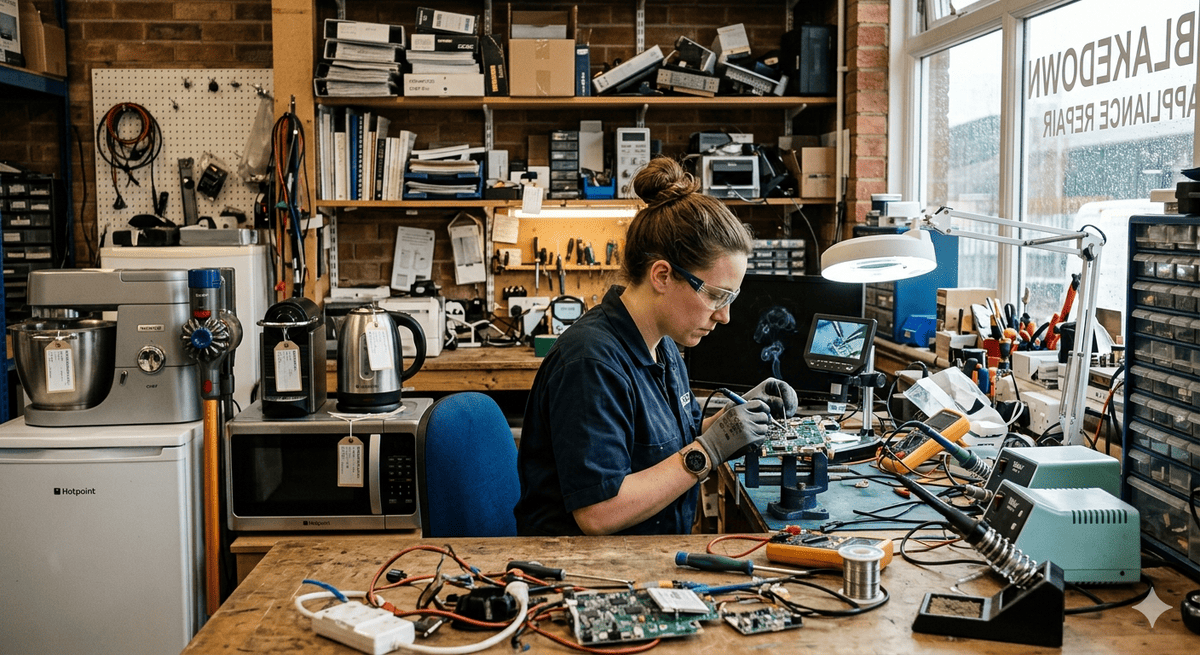
How Brands Lose Aftermarket Revenue to Third-Party Repair
You designed the product. You engineered the components. You published the service manual. And when something goes wrong, a customer walks into a high-street repair shop and gives that business your money.
The global aftermarket repair and service market is large, and original equipment manufacturers capture only a portion of it. The scale is real: the global automotive aftermarket alone was worth hundreds of billions of dollars in 2024, and parts-and-service is a major value pool across durable goods more broadly. The rest of that revenue flows to independent repairers, third-party service networks, and grey-market parts suppliers who had nothing to do with building the product in the first place.
That is not a small rounding error. It is a structural revenue leak, and most manufacturers have no strategy to address it beyond hoping customers find their way to an authorised service centre.
The good news: digital product identity gives you the infrastructure to close the gap.
Why Customers Choose Third-Party Repair
Before dismissing independent repairers as a problem to be legislated away, it is worth understanding why customers go there in the first place. The reasons are rational, not disloyal.
Price. An independent repairer in a local shopping centre often undercuts OEM authorised service on common repairs. For a consumer facing a higher quote from the manufacturer versus a cheaper one from the shop downstairs, the choice is obvious, especially outside the warranty period.
Speed. Authorised service networks are often built for volume, not urgency: long booking windows, couriering devices away for a week, waiting for parts to arrive from a central depot. Independent repairers frequently offer same-day or next-day turnaround because they hold common stock locally and have no bureaucratic approval chain.
Convenience. Drop-in repair, walk-in assessment, geographic proximity. For a tradesperson whose power tool is their income, or a household that cannot function without an appliance, proximity to a repairer matters more than brand affiliation.
Perception of equivalence. Customers often assume that a repair is a repair. Unless the OEM has done the work to communicate what makes authorised service genuinely different, there is no perceived quality gap, only a price gap.
This is not a failure of customer loyalty. It is a failure of brand-to-product connection. The product sits in a customer's home with no live link back to the manufacturer. When it breaks, the manufacturer is simply not in the room.
Where the Revenue Actually Goes
Consider a mid-range home appliance with a long useful life. Over that period, there may be one or two service events: a heating element, a pump, a control board. The OEM designed the product, stocks the genuine parts, and trains technicians to service it correctly. Yet a large share of out-of-warranty repairs are completed by independent technicians using non-genuine or sourced-equivalent parts.
Multiply that across a product portfolio of many units and the arithmetic becomes uncomfortable. Suppose a manufacturer ships a large annual volume, each unit carrying meaningful aftermarket service value over its lifetime. If only a minority of that service work flows back through authorised channels, a substantial revenue line is left on the table, year after year, on a single product line.
This is why the most commercially switched-on manufacturers do not treat after-sales service as a cost centre. They treat it as a revenue line.
OEM vs. Third-Party Repair: The Real Comparison
The argument for authorised repair is strong, but it is rarely communicated effectively at the moment a customer is making their decision.
| Dimension | OEM Authorised Repair | Independent Third-Party |
|---|---|---|
| Parts quality | Genuine OEM components, exact tolerances | Sourced equivalents, variable quality |
| Technician training | Brand-certified, product-specific training | General skills, self-taught on model |
| Warranty impact | Warranty status preserved | Warranty status may be affected |
| Data security | Controlled environment, brand protocols | No standardised data handling |
| Resale value | Full service history maintained | Gap in provenance record |
| Cost | Often higher upfront | Often lower upfront |
| Availability | Fixed network, may require travel or courier | Local, walk-in, immediate |
The OEM tends to win on quality and risk dimensions. The independent tends to win on cost and convenience. The question is not how to eliminate independent repair. It is how to make the OEM option competitive on the dimensions that lose customers.
Where Digital Product Identity Changes the Economics
The reason manufacturers lose customers at the repair moment is not price alone. It is friction. The customer does not know how to find their nearest authorised repairer. They do not know whether the product is still within warranty. They cannot quickly order a genuine spare part. The path of least resistance points them somewhere else.
A product with a digital identity changes that friction profile entirely.
When a customer scans the product, at unboxing, during a fault, or at end of life, they reach a live product experience that knows what the product is, who owns it, and what its service history looks like. From that single scan, the manufacturer can present:
- Book an authorised repair: A direct link to the nearest certified service centre, with live availability and booking confirmation
- Order genuine parts: A curated parts catalogue matched to that exact serial number, with direct purchasing and verified fit
- Point to authorised repair: The manufacturer's own routing for authorised repair, rather than leaving the owner to search
The product scan replaces a web search. Instead of typing "washing machine repair near me" and landing on whoever has the best local SEO, the customer is directed straight into the manufacturer's authorised network. The OEM stops competing on organic search and starts owning the service journey at the product level.
This is a direct intervention in the decision moment that determines where repair revenue flows.
For more on the revenue streams product scans reveal, see connected product ROI.
The Quality Argument: Make It Louder
The case for OEM repair is compelling, but manufacturers rarely make it clearly or at the right moment. It needs to be stated plainly, at the point of need:
Genuine parts fit exactly. Third-party components may be dimensionally close, but tolerances in motors, seals, and electronic assemblies matter. An off-spec part that passes initial testing can fail early or cause cascading damage.
OEM repair can protect warranty cover. Depending on the jurisdiction and the terms of the warranty, a repair using non-genuine parts or carried out by an uncertified technician may affect remaining cover. Customers who do not know this can be caught out when they make a subsequent claim.
Service history affects resale value. For higher-value durables such as appliances, tools, HVAC equipment, and vehicles, a documented OEM service history is a material asset. A product with a full verified service record can command a higher resale price than an equivalent unit with a patch job from an unknown repairer.
Data security is not trivial. Smart products hold credentials, account data, and usage history. An authorised repair environment handles this under defined protocols. An independent repairer has no such obligation.
None of this is communicated effectively by a sticker on the product or a line in the manual. It needs to be surfaced at the scan moment, when the customer is already in a repair-decision mindset.
Right to Repair: Friend, Not Enemy
Right to Repair rules, now appearing in varying forms across several major markets, are frequently framed by manufacturers as a threat. They are more accurately an opportunity, if approached correctly.
Right to Repair measures generally give customers and independent repairers more access to parts, tools, and documentation. They do not prevent OEMs from being the best repair option. They do not make independent repair more trustworthy or higher quality. They simply make it more accessible.
The manufacturers who stand to benefit most are those who use the regulatory moment to build the infrastructure that makes OEM service genuinely competitive. Publish your parts catalogue. Certify more technicians. Build the digital connection that makes booking an authorised repair as easy as searching the web.
For a deeper analysis of how manufacturers can turn the Right to Repair into a competitive advantage rather than a compliance burden, see Right to Repair as a Competitive Advantage for Manufacturers. A strong warranty registration system tied to product identity helps in proving that authorised repairs preserve customer protections.
Right to Repair gives customers a choice. It does not guarantee they will choose the independent. A manufacturer who has invested in digital product identity, a well-networked authorised service base, and clear quality communication is well-positioned to win that choice on merit.
Building the Infrastructure
Closing the third-party repair gap depends on the digital connective tissue between product and after-sales service. Some tools focus on product registration and owner relationships. Others focus on service parts management and after-sales supply chains. Each tends to address part of the problem.
The fuller opportunity, connecting product identity at the serial level to live service booking, genuine parts ordering, repairer verification, and ongoing owner engagement, calls for a more integrated approach to what happens after the sale.
This is the operating system layer that sits between the physical product and the customer relationship.
Keeping Customers in Your Service Ecosystem
The repair moment is not a one-off transaction. It is a pivot point in a customer's relationship with the product and the brand. A customer who has a good authorised repair experience is more likely to register subsequent purchases, extend their warranty, buy genuine accessories, and remain in the OEM's commercial orbit. Understanding warranty claim automation and how it supports the repair journey is key to making authorised service feel effortless.
A customer who repairs through an independent and has no friction in doing so has effectively been released from the brand relationship. They are now a customer of the repairer, not the manufacturer.
This compounds over time. The out-of-warranty service period for many durable goods spans several years. Over that period, the cumulative value of keeping a customer engaged with authorised service, through parts, labour, accessories, and next-purchase loyalty, can be substantial for many product categories.
What the Transition Looks Like in Practice
A manufacturer beginning to close the third-party repair gap does not need to rebuild their entire service network overnight. The practical steps are incremental:
- Embed serialised digital identities on every product at manufacture: a GS1 Digital Link QR or similar that resolves to a live, updatable product experience
- Build the scan-to-service flow: when a customer scans, present authorised repair booking, genuine parts ordering, and repairer verification as primary actions
- Publish the quality argument: make the case for genuine parts and certified technicians at the moment of need, not buried in the manual
- Expand the authorised network: more certified technicians in more locations reduces the convenience gap that independent repairers currently exploit
- Track the service journey: serial-level scan data tells you when customers are in a repair-decision moment, which products generate disproportionate service demand, and whether your authorised network is being found
None of this requires customers to download an app or create an account. The scan is the entry point. The manufacturer controls what happens next.
Frequently Asked Questions
Does directing customers to authorised repair conflict with Right to Repair rules?
No. Right to Repair measures generally require manufacturers to make parts and tools available to independent repairers and customers. They do not prohibit manufacturers from operating authorised service networks or from marketing OEM repair as the preferred option. Providing a digital pathway to authorised service alongside the availability of independent options is consistent with that, and strategically sound.
How does a product scan help at the repair moment specifically?
When a customer scans a serialised QR code on a product, the manufacturer controls where that scan resolves. Instead of directing the customer to a generic product page, the scan can surface context-aware content: whether the product is still in warranty, where the nearest authorised repairer is, and which genuine parts are available for this specific model and serial number. The scan replaces a web search and puts the OEM in control of the service discovery journey.
What happens to the service revenue argument if the customer bought second-hand?
It strengthens it. A second-hand buyer has no OEM relationship at all: they bought from a third party and have no direct contact with the manufacturer. A product with a digital identity can initiate that relationship at first scan, regardless of how many times the product has changed hands. Ownership transfer, warranty re-registration, and service history access all become possible at the scan moment. The manufacturer gains a customer they would otherwise never have known existed.
The aftermarket is not going away. Neither are independent repairers, nor should they. But there is no strategic reason why OEMs should continue to hand over the majority of post-sale service revenue to businesses that had no part in building the product.
The manufacturers who will close this gap are those who understand that digital product identity is not a compliance investment or a marketing gimmick. It is the infrastructure that makes every product a live connection to its owner, including at the exact moment that owner is deciding where to spend their repair budget.
BrandedMark is the Product Operating System for manufacturers of physical goods: serialised product identity, connected experiences, warranty registration, and Digital Product Passport readiness in one platform. See how it works at brandedmark.com.