B2B Equipment Resale: How Digital Identity Changes Everything
A construction company puts a three-year-old telehandler up for sale. It has been well maintained, serviced on schedule, had its inspections done on time, and never been involved in an incident. The owner knows this. The potential buyer does not, and because they cannot verify any of it, they offer a discount to compensate for the uncertainty.
That discount is not a negotiating tactic. It is the price of unverifiable history.
The UK used commercial equipment market spans industrial machinery, construction plant, commercial vehicles, medical equipment, and specialist tooling. Across every one of those categories, the same dynamic plays out: a trust gap between what a seller knows about their asset and what a buyer can verify. Digital product identity closes that gap, and in doing so it restructures the economics of the entire secondary market.
The B2B Resale Market Is Not Like Consumer Resale
It is tempting to frame used equipment in the same terms as consumer second-hand markets: online platforms, the growth of pre-owned culture, sustainability-driven buying. The mechanics are superficially similar. An owner sells an asset they no longer need, and a buyer acquires it at below-new pricing.
But B2B equipment resale operates on entirely different stakes. A private buyer purchasing a second-hand espresso machine and finding it underperforms loses a modest sum. A logistics company acquiring a fleet of used forklifts with undisclosed hydraulic faults loses operational continuity, faces regulatory scrutiny, and potentially exposes workers to safety risk. A hospital buying refurbished imaging equipment without full service documentation faces approval delays and clinical risk.
The consequences of information asymmetry scale with asset value and criticality. In B2B equipment, both of those are high.
The Scale of the Trust Gap
Established marketplaces for heavy plant and industrial equipment have done significant work to bring liquidity to the used equipment market. They aggregate inventory, provide inspection reports, and in some cases offer condition guarantees. But a third-party inspection report is a snapshot: it records condition on a given day, not the full maintenance history, and it is produced by an assessor who was not present for the asset's working life.
What the buyer of a second-hand CNC machine, excavator, or imaging scanner actually needs is not only an independent inspection. It is the complete operational record: every scheduled service, every repair, every parts replacement, every compliance check, and the current status of any remaining warranty coverage. That record often lives in maintenance management systems, spreadsheets, and paper files, and it frequently does not travel with the asset when it changes hands.
What Digital Identity Enables at the Point of Sale
When a piece of commercial equipment carries a persistent digital identity from manufacture, serialised, tamper-evident, and linked to a live record, the resale transaction changes fundamentally.
For that to change, the record attached to the asset has to carry:
- Remaining warranty coverage: whether any manufacturer warranty is still active on this specific unit
- Returns and repairs: return and repair cases raised against this serial number, and how each was resolved
- Support history: support cases opened against this unit, and their outcomes
- Ownership record: who registered the unit, and each transfer of ownership since
- Manufacturer safety notices: any recall that applies to this specific serial range
This is not the seller's self-reported claims. It is a read from records linked to that asset's unique serial number, accumulated from the point the unit was registered onward, created by people with no stake in the resale outcome.
That shift from seller-asserted to independently recorded is the trust primitive the B2B resale market has lacked.
The Value Differential in Practice
| Dimension | Without Digital Identity | With Digital Identity |
|---|---|---|
| Pricing | Discounted to offset uncertainty | Closer to true market value; verifiable quality supports a premium |
| Time to sale | Extended due diligence and inspection delays | Buyer confidence accelerated; faster transaction |
| Buyer pool | Limited to buyers willing to accept risk | Broader pool including risk-averse buyers in regulated industries |
| Dispute risk | Post-sale disputes over undisclosed history | Transparent record reduces grounds for dispute |
| Warranty and recall status | Chased by phone and email | Read from the unit's own record |
| Warranty status | Unknown or unverifiable | Recorded against the unit and visible to a prospective buyer |
| Parts identification | Manual lookup by model number | Scan links directly to parts diagrams and availability |
The discount buyers apply to unverifiable history is not arbitrary. It reflects the real cost of due diligence, the risk of hidden faults, and the uncertainty of compliance status. Digital identity reduces those costs for the buyer, which means the seller can capture value rather than discounting it away.
Sector by Sector: Where the Difference Is Largest
Industrial Machinery
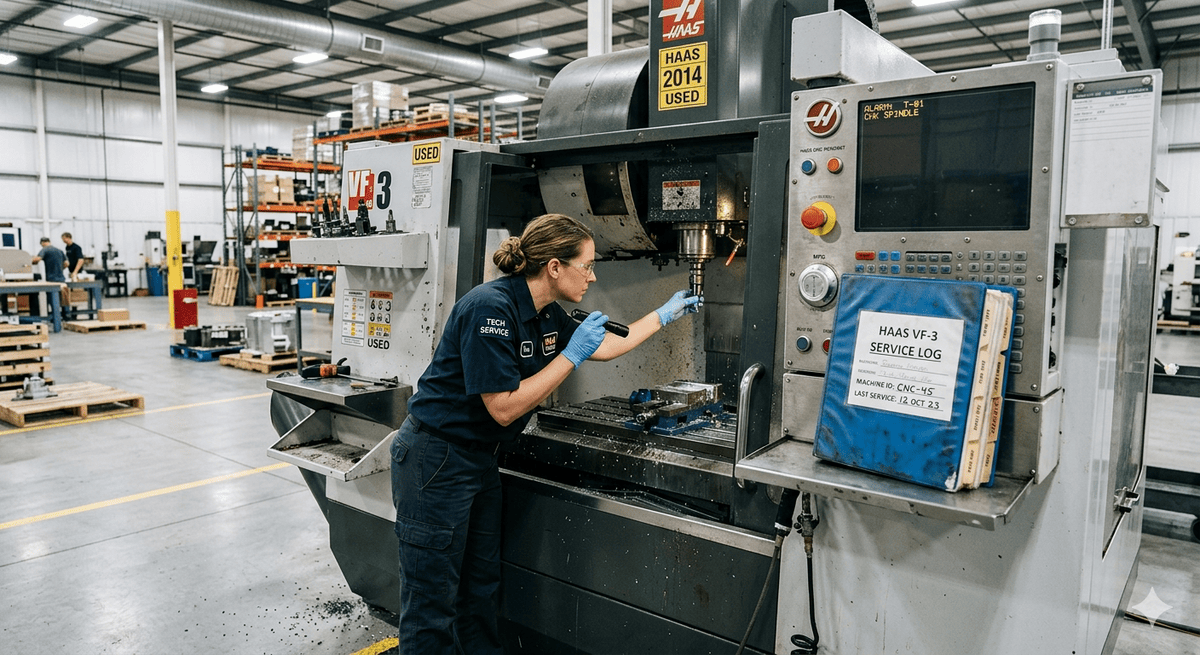
CNC machining centres, injection moulding machines, industrial presses, and specialist fabrication equipment can represent substantial capital values. At those values, even a small discount for unverifiable history can represent a meaningful sum in lost seller value. The service history of a high-precision machine, including spindle calibrations, tooling changes, and coolant system maintenance, is directly relevant to the precision output the buyer can expect. Without it, a buyer with quality requirements has to assume the worst.
Medical Equipment
Refurbished medical devices are a notable market segment: ultrasound machines, patient monitors, infusion systems, surgical instruments. Buyers in regulated healthcare settings typically require documented evidence that refurbished devices meet safety and performance standards. Without a verifiable service and calibration record, such equipment can be difficult to sell into those settings at all. A record that shows who owned the unit, what was returned or repaired against it and whether any recall applies can directly affect whether an asset is saleable into regulated healthcare.
Construction Plant
Excavators, telehandlers, concrete pumps, and specialist lifting equipment carry mandatory inspection requirements. At resale, the buyer needs to know not just the current certificate status but the full inspection history and any previous failures or near-misses. Plant that has been well-maintained and consistently certified can be more attractive than equivalent plant where the documentation is incomplete. Digital identity moves the verifiable part of that picture off the seller's word and onto the unit's own record.
Commercial Vehicles
Fleet operators selling light commercial vehicles, HGVs, and specialist transport face a market where buyers are sophisticated about checking maintenance and service records. But even here, the record is often fragmented: a mix of main dealer services, independent garage visits, and operator-completed checks that never get consolidated. A persistent digital identity for the vehicle that aggregates those records into a single scannable history would change the resale proposition for fleet operators.
The OEM Opportunity: A New Customer Relationship at Resale
For original equipment manufacturers, the secondary market has historically been a blind spot. A product is sold to its first owner and the manufacturer's relationship often effectively ends there, unless a recall forces contact. Second and subsequent owners are frequently invisible. They buy parts through distributors, get serviced by independent engineers, and the OEM may have little data about the asset's working life after the first transaction.
Digital identity can change this. When an asset changes hands, the transfer is recorded against the unit. That scan is an introduction, an opportunity to establish the same relationship with the second owner that the OEM had with the first. Onboarding documentation, parts and service recommendations, extended warranty offers, training resources: all of those can be served to the new owner at the moment they take possession of the asset.
For OEMs, this is not only a customer relationship opportunity. It is a signal about the secondary market for their products: which models hold their value, which sectors are active resellers, and what the typical working life looks like before first resale. That data has potential commercial value for product development, pricing strategy, and parts forecasting.
The manufacturer who knows their installed base across all owners, not just first owners, has a fundamentally better picture of their product's life in the market.
Circular Economy: Digital Identity Extends Asset Life
B2B equipment resale is the circular economy working at scale. A well-maintained excavator with a full service history that sells at close to market value and goes on to work productively for years is exactly the outcome circular economy policy is trying to create. The environmental case for extending commercial asset life is straightforward: a heavy machine embodies considerable manufacturing input, and every year of additional productive use displaces some of the footprint of building a new unit.
The challenge is that the circular economy in B2B equipment can be throttled by the trust gap. Assets that could command a fair secondary market value may instead get scrapped or exported to less regulated markets because the seller cannot substantiate their value, or because the due diligence burden is too high for a buyer to absorb.
Digital identity addresses that throttle directly. When the service and compliance record travels with the asset, the transaction can become viable at higher value, which means the asset is more likely to stay in productive use rather than being written off. Extended asset life, reduced manufacturing demand, and verifiable compliance throughout: this is what the circular economy can look like when information infrastructure matches physical infrastructure.
The resale advantage is particularly strong when digital identity includes a clear product data strategy that manufacturers can use for both the first and second owner. For how this same principle applies to high-value consumer goods, see certified pre-owned programmes.
How BrandedMark Enables B2B Equipment Digital Identity
BrandedMark is built for high-value physical assets that move through multiple owners and need a record that travels with the unit rather than with the seller.
For commercial equipment, the implementation is built around serialised digital identity applied at manufacture, a unique identity per unit that persists through the asset's entire working life, regardless of how many times it changes hands. Warranty status, returns and repairs, support cases and ownership transfers are all recorded against the serial number. Ownership transfers are recorded and time-stamped. Remaining warranty status can be surfaced on the product's own experience page.
For sellers, that means a verifiable record that supports a fair asking price. For buyers, it means confidence with less of the due diligence burden. For OEMs, it means an opportunity for a new customer relationship at every resale. And for the assets themselves, it means a higher probability of remaining in productive use rather than being discarded before their time.
The trust gap in the B2B resale market is not a market failure. It is an information problem, and information problems are solvable.
For manufacturers looking to understand the full lifecycle value of product registration and ownership, see digital product identity guide for implementation patterns. For equipment hire operators who need the same compliance visibility for assets on hire rather than at resale, consider how warranty registration can extend into operational tracking.
Frequently Asked Questions
Does digital identity actually change resale prices, or is it just a nice-to-have feature?
The logic is straightforward: verifiable history reduces a buyer's uncertainty, and uncertainty is what drives the discount on used assets. In B2B equipment, where asset values are higher and buyers tend to be sophisticated, the case for documentation is correspondingly stronger. A seller who can demonstrate that an asset has been maintained, inspected, and certified to specification removes much of the reason a buyer would discount it. Whether that translates into a higher final price depends on the asset, the sector, and the buyer, but it directly addresses the source of the discount.
How do you handle the practical problem of accumulated paper records, where an asset may have years of service history before digital identity is implemented?
Retrofitting digital identity to existing assets is a real implementation challenge, but it is not an obstacle. The approach is to establish the digital record from the point of implementation forward, keeping historical paperwork where it already lives and using the digital record for everything from that point on. A buyer evaluating the asset can then see the complete picture: a digitised historical record plus a fully digital forward-looking history from the point of implementation. For assets approaching first resale, even partial digitisation of the historical record can change the transaction dynamic.
What happens to the digital identity record if the equipment is significantly repaired or rebuilt?
Major repairs, engine rebuilds, and component replacements are precisely the events that should be most prominently recorded in a digital identity record, not obscured. A transparent repair history, showing what was returned, its condition and how it was resolved, can be more reassuring to a sophisticated buyer than a suspiciously clean record. The digital identity record does not reset at ownership transfer or major service; it accumulates. That accumulation is the value. An asset with a transparent record of the returns and repairs raised against it can be more sellable than one with an incomplete or ambiguous history.
BrandedMark is the Product Operating System for manufacturers of physical goods: serialised product identity, connected experiences, warranty registration, and Digital Product Passport readiness in one platform. See how it works at brandedmark.com.